What Is the Art Historical Movent the Birth of Venus Belongs Too
Birth of Venus
- Appointment of Creation:
- 1486
- Height (cm):
- 172.50
- Length (cm):
- 278.l
- Medium:
- Tempera
- Support:
- Canvas
- Framed:
- No
- Art Movement:
-
Renaissance
- Created by:
- Current Location:
-
Florence, Italian republic
- Displayed at:
-
Galleria degli Uffizi
- Nascency of Venus Page's Content
- Story / Theme
- Inspirations for the Work
- Analysis
- Critical Reception
- Related Paintings
- Locations Through Fourth dimension - Notable Sales
- Creative person
- Art Period
- Bibliography
-

Hesiod
-
Angelo Poliziano

During the 1480s in Florence information technology was not uncommon for artists and intellectuals to gather together, typically around a powerful heart, such every bit in the courts of Princes or rich families such as the Medici's. This new vanguard of men made it their mission to recreate the past and relive information technology through translating and comprehending the works of Virgil, Homer and Hesiod.
It is said that every day Lorenzo the Bang-up assembled groups of humanists, philosophers and artists to form a literary society who interpreted works and formed ideas that were then translated past the artists, painters, goldsmiths and musicians.
The Nascency of Venus was a theme launched by Lorenzo and information technology was he who had it fix to poesy past one of his favorite humanist poets, Angelo Poliziano. This filtered through to Botticelli and he scrupulously followed the text in society to design the artwork.
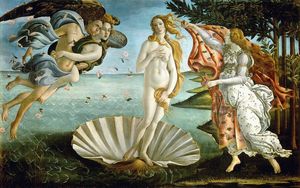
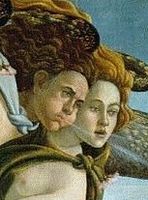
Angelo Poliziano's stanzas were based on an ode by Hesiod. In the story nosotros see the aftermath of Venus's creation, pushed along by the Gods of the winds, Zephyr and Aura, who, on the showtime twenty-four hour period of Creation, elevated this shell bearing Venus' triumphant nudity from the unknown depths of the ocean. Budgeted the earth over which she volition assume her true role, she becomes all of a sudden small-scale, and notice the opinion, which Botticelli borrowed directly from the beautiful examples of the antiquarian, Venus Pudicae, that were being discovered at that fourth dimension.
For this modesty to take on its sacred nature, ane of the Graces, in the name of all 3, is there to encompass her with her cape. The Graces take the privilege of covering Venus' nudity and transforming her into the mother and patron saint of all the forces of cosmos. Venus is in the process of landing. Information technology should exist pointed out that the shore she is landing on is very rugged and already has tall copse, both laurel and myrtle, and that the trees are crowded together, their leaf obscuring one another.
At that place are several details that illustrate Venus' triumphant magnificence. Fine art historians know that until recently, this Birth of Venus had been lavishly covered with varnish, which ways that the successive coats of varnish had completely opacified. The painting has been superbly cleaned, and today's viewers are able to discover a new Botticelli with pearly mankind, most translucent pare and the eerily green bluish of the sea.
-
Nascency of Venus
It is in keeping with Renaissance era inspiration that one of Botticelli's nearly famous paintings represents not a Christian legend, simply a classical myth - the Birth of Venus. Whilst the works of the classical poets had been known through the eye Ages, it was merely at the time of the Renaissance, when the Italians tried so passionately to recapture the former glory of Rome that classical myths become pop among educated laymen.
For the men of the Renaissance, the mythology of the Greeks and Romans represented a superior class of truth and wisdom. Whilst Botticelli carried out the artwork, information technology is highly likely that the commissioner (a member of the powerful Medici) provided the original source of inspiration and that either he, or one of his learned friends, explained to the artist what was the story, equally recounted by the ancients regarding Venus ascension from the sea. The story would have been seen equally a symbol of mystery in which the divine message came into the globe, and Botticelli has done his all-time to depict this myth in a worthy manner.
-
Venus
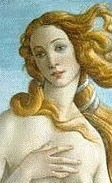
Botticelli'southward Venus, the goddess of love, is one of the first non-biblical female nudes in Italian art and is depicted in accord with the classical Venus pudica. Still, she is as far equally a precise copy of her image equally the painting is an exact analogy of Poliziano's poetry. The group comprising Venus and the Hora of spring demonstrates Botticelli'southward flexible use of Christian ways of depiction.
-
Nascency of Venus
-
Birth of Venus
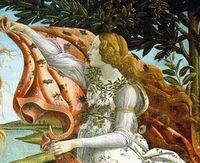
Limerick:
Botticelli'south Birth of Venus is one of the most treasured artworks of the Renaissance. In it the goddess Venus (known as Aphrodite in Greek mythology) emerges from the body of water upon a shell aligned with the myth that explains her nascence. Her shell is pushed to the shore from winds existence produced past the current of air-gods in amongst a shower of roses. As Venus is about to stride onto the shore, a Nymph reaches out to cover her with a cloak.
Venus is illustrated as a cute and chaste goddess and symbol of the coming bound. Her depiction as a nude is pregnant in itself, given that during this time in Renaissance history well-nigh all artwork was of a Christian theme, and nude women were hardly ever portrayed.
Many aspects of Botticelli's Nativity of Venus are in move. For instance, the leaves of the orangish copse in the background, ringlets of hair being blown by the Zephyrs, the roses floating behind her, the waves gently breaking, and the cloaks and drapery of the figures blown and lifted by the breeze.
The pose of Botticelli'south Venus is reminiscent of the Venus de Medici, a marble sculpture and gem inscription from Classical antiquity in the Medici drove which Botticelli had opportunity to report.
Use of technique:
Botticelli's Venus was the first large-calibration sheet created in Renaissance Florence. He prepared his own tempera pigments with very little fat and covered them with a layer of pure egg white in a process unusual for his time. His painting resembles a fresco in its freshness and brightness. Information technology is preserved uncommonly well and the painting today remains firm and elastic with very trivial cracks.
Color palette:
Venus'due south long gilded pilus sweeps gracefully nigh her. This use of golden may have been inspired by Donatello'south Penitent Magdalen.
Mood, tone and emotion:
Birth of Venus is dependent on the delicacy of Botticelli's line. The proportions show their greatest exaggeration, notwithstanding the long neck and torrent of hair help to create the mystifying figure.
-
Quick fact:
Most paintings of women during the heart Ages symbolize the Virgin Mary, showing her in a demure appearance with an angelic smiling and covered caput. So Botticelli's depiction of a beautiful goddess, not simply an obvious symbol of pagan mythology simply also painted equally a nude was groundbreaking.
Having been one of the virtually esteemed painters in Italia during his lifetime, Botticelli was quickly overshadowed by the artists of the High Renaissance and long ignored after his expiry. This included a long-term overlooking of his Magnus Opus, the Nascency of Venus.
Botticelli's reputation did not enjoy a notable rise in critical esteem until the end of the 19th century when important paintings by the artist gradually entered the nifty museums of Europe.
During the 1860s Primavera (see Related Paintings below)and Birth of Venus were given prominent public display for the first time in the Galleria dell'Accademia in Florence. The museum'due south acquisitions proved slightly in advance of public and critical response, yet paved the manner for more than in-depth study to be made on the artwork of Botticelli.
What originally sparked this revival of interest in Botticelli was a developing curiosity in the 19th century of the literary and political culture in Florence at the time of Lorenzo the Slap-up, and the resultant ascent in appreciation for the arts gimmicky with him.
-
Primavera
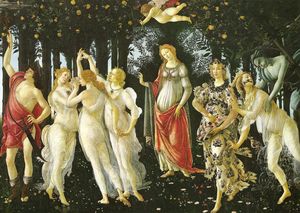
Related works past Botticelli:
Primavera, 1482:
Primavera and Nascency of Venus show two parts of Venus. Botticelli painted them to exist companion paintings and hung in the same space and both bring across the theme that honey triumphs over brutality. In the Birth of Venus, Venus has just been born and arriving on earth. The copse have non yet produced fruit. The earth is waiting her arrival. In Primavera, however, she is amidst large fruits and lush flowers and has arrived at a mature state. She is presiding over the aforementioned world in each separate piece of work.
-
Galleria degli Uffizi

Information technology is uncertain who exactly commissioned the Nascence of Venus. In the starting time one-half of the 16th century, it was kept in the Castello Villa, owned by the descendants of Lorenzo di Pierfrancesco de' Medici. However, it was never mentioned in inventories of his property. It is, though, extremely likely that Nativity of Venus was commissioned for a country seat.
In contrast to the Primavera, the painting was created using canvas. This was a medium normally chosen for paintings that were destined to decorate country houses, considering canvas was less expensive and easier to send than wooden panels.
Today the painting tin can be found in the Galleria degli Uffizi, Florence.
-
The Return of Judith to Bethulia
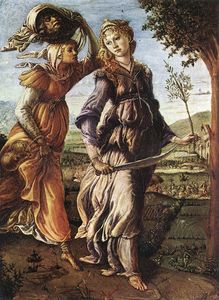
Sandro Botticelli was an Italian painter and draughtsman. During his lifetime he was one of the most acclaimed artists in Italy, and equally such was summoned to take part in the decoration of the Sistine Chapel in Rome and earned the patronage of the leading families of Florence. His works for such esteemed Florentines include Nascency of Venus.
However, Botticelli's reputation had already begun to wane during his lifetime. He was overshadowed first past the advent of a new style by Perugino and Francesco Francia and then totally eclipsed with the institution of High Renaissance style, with the paintings of Michelangelo and Raphael in the Vatican. Botticelli's genius was rediscovered some centuries later on in the latter part of the 19th century.
-
Admiration of the Magi
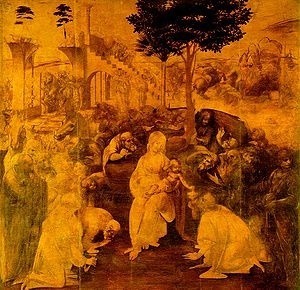
As mythology paintings entered into Renaissance art, Botticelli broke new ground with his works, including the Birth of Venus. He was the first to create large scale mythology scenes, some based on historical accounts. Botticelli chose to center his mythology work on what the Medici family unit requested, peculiarly the younger generation.
In the era that Birth of Venus was painted, minds were open to new ideas and organized religion no longer needed to be the main bailiwick of artistic work. If such mythological pieces had been painted 100 years before, they would not have been accepted by the church because they were so different to traditional depictions.
To read more about Botticelli and his works please choose from the post-obit recommended sources.
• Zollner, Frank. Botticelli. Prestel, 2009
• Basta, Chiara. Botticelli. Rizzoli International Publications, 2005
• Altcappenberg, Dr. Hein Schultze. Sandro Botticelli: The Drawings for Dante'south Divine Comedy. Imperial University of Arts, 2000
• Lightbrown, R. West. Botticelli: Life and Piece of work. Abbeville Printing Inc, 1996
• Proud, Linda. The Rebirth of Venus. The Godstow Press, 2008
• Gebhart, Emilie. Botticelli. Parkstone Inter, 2010
Source: https://www.artble.com/artists/sandro_botticelli/paintings/birth_of_venus
0 Response to "What Is the Art Historical Movent the Birth of Venus Belongs Too"
Post a Comment